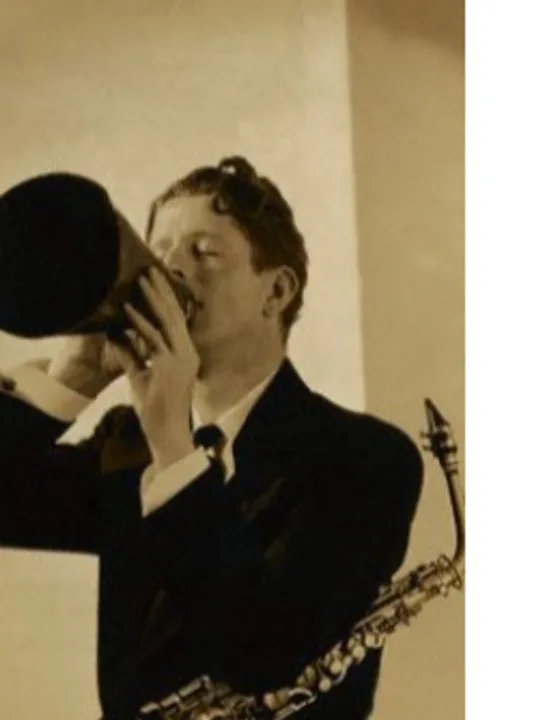
Rudy Vallée was one of the most recognized voices in America by 1929, but his private life was as turbulent as his career was successful. Four marriages, documented feuds, a reputation for being difficult, and a personality that colleagues described as obsessive and controlling — the man behind the megaphone was far more complicated than the crooning matinee idol his public image suggested.
Early Life and Family Background
Hubert Prior Vallée was born on July 28, 1901, in Island Pond, Vermont. His family relocated to Westbrook, Maine, where his father ran a pharmacy. The New England upbringing gave Vallée a practical, business-minded framework that stayed with him throughout his life — often to the frustration of people around him.
Key biographical facts:
- Birth name: Hubert Prior Vallée
- Adopted stage name "Rudy" as a teenager, after saxophonist Rudy Wiedoeft
- Studied at the University of Maine before transferring to Yale University
- Graduated from Yale in 1927 — a credential he referenced publicly for decades
- His Yale connection directly shaped his brand: "The Vagabond Lover," the Connecticut Yankees, the collegiate persona
His father's pharmacy background influenced Rudy's meticulous recordkeeping. Vallée archived personal correspondence, financial records, and press clippings in a volume that was unusual even by Hollywood standards. Much of this archive eventually became source material for researchers studying early radio and film history.
The Four Marriages
Vallée married four times. Each marriage reflected a different chapter in his public and private identity.
| Marriage | Spouse | Years | Notes |
|---|---|---|---|
| 1st | Leonie Cauchois | 1928 | Lasted less than a year; rarely discussed publicly |
| 2nd | Fay Webb | 1931–1936 | High-profile; ended in contested divorce |
| 3rd | Jane Greer | 1943–1944 | Brief; Greer was 18, Vallée was 42 |
| 4th | Eleanor Norris | 1944–1986 | Lasted until his death; 42-year age difference |
First Marriage: Leonie Cauchois
Little documentation exists about this marriage in mainstream biographical sources. It was annulled or dissolved within months and Vallée rarely acknowledged it in interviews. Some archival sources from the 1930s omit it entirely.
Second Marriage: Fay Webb
This was the marriage that attracted significant press coverage. Fay Webb was the daughter of a Santa Barbara police chief. The couple married in 1931 at the height of Vallée's radio fame. The divorce proceedings in 1936 were contentious — Webb's family made public accusations, and the settlement details were reported in newspapers across the country. Vallée's public image took a measurable hit during this period, though his radio ratings remained strong.
Third Marriage: Jane Greer
Jane Greer went on to become a notable film noir actress, most recognized for her role in "Out of the Past" (1947). At the time of the marriage she was 18; Vallée was 42. The union lasted approximately a year. Greer later spoke carefully about the relationship in interviews, describing a significant mismatch in expectations. The marriage ended before her film career began in earnest.
Fourth Marriage: Eleanor Norris
Eleanor Norris was 23 when she married Vallée in 1944. He was 43. This marriage lasted until Vallée's death in 1986 — 42 years. By most accounts it was the stabilizing relationship of his life. Norris managed significant portions of his later career logistics and was involved in preserving his archive. Vallée had no biological children. Eleanor outlived him and remained connected to efforts to document his legacy.
Personality: What Colleagues and Contemporaries Said
Vallée's reputation among peers was mixed in ways that went beyond ordinary professional rivalry.
Documented personality traits from multiple sources:
- Litigious: Vallée filed or threatened legal action over contracts and royalties with notable frequency
- Credit-obsessed: He insisted on top billing even in situations where contemporaries considered it unnecessary
- Meticulous to a fault: His personal archive contained thousands of items; staff described the organizational demands as extreme
- Financially controlling: Multiple accounts from collaborators reference disputes over pay and expenses
- Publicly thin-skinned: He responded to negative press with letters to editors and, in some cases, direct confrontation
Eddie Cantor, Bob Hope, and Milton Berle all worked alongside Vallée at various points. Berle's memoirs contain passages that describe Vallée as someone who could not separate his ego from professional interactions. Hope, known for sharp observations about peers, was notably neutral about Vallée in public — which some biographers read as deliberate distancing.
Alice Faye, who appeared on Vallée's radio program before her film career accelerated, credited him with giving her early exposure. This is one of the more unambiguous positive accounts from a major contemporary.
The Yale Identity
Vallée's connection to Yale was not incidental — it was a load-bearing part of his self-image. He led a band called the Yale Collegians before renaming them the Connecticut Yankees. He referenced his Yale degree in promotional materials for years after graduation. In 1930s America, a Yale degree carried significant class signaling. For an entertainer navigating the boundary between low-culture radio performance and mainstream respectability, it was a useful credential.
This created friction. Colleagues from working-class backgrounds found the constant Yale references grating. Critics occasionally pointed out the irony of a megaphone crooner leveraging Ivy League credentials to claim cultural legitimacy.
Feuds and Public Conflicts
Vallée's personal life intersected with his professional feuds in ways that were difficult to separate.
Notable documented conflicts:
- John Barrymore: Reportedly clashed on film sets over status and attention; specific incidents referenced in Hollywood trade press from the early 1930s
- Press critics: Vallée's responses to negative reviews were aggressive enough to be commented on by other entertainers
- Radio network executives: Contract disputes with NBC in the 1930s became part of industry lore about talent negotiation
- Bandleader peers: Competitive dynamics with contemporaries including Rudy's near-namesake competitor acts were a source of ongoing tension
The pattern across these conflicts was consistent: Vallée interpreted professional criticism as personal attack and responded accordingly.
Home Life and Living Arrangements
Vallée owned property in Hollywood that became known in industry circles. His home was described in multiple period sources as something between a personal museum and a working archive — walls covered with photographs, shelves with recordings and memorabilia, filing systems for correspondence.
He was not known as a socialite in the traditional Hollywood sense. He did not host the kinds of large parties that characterized the social calendars of comparable stars. His entertaining was more controlled, more selective. Accounts describe dinners where Vallée dominated conversation and expected guests to engage with his areas of interest — primarily his own career history and opinions on the music industry.
He did not smoke heavily and was not associated with the drinking culture that consumed several of his contemporaries. His vices, to the extent they were documented, ran toward vanity and control rather than substance.
Later Personal Life and Aging
By the 1960s Vallée had transitioned into a character actor and occasional television personality. His willingness to self-parody — most visibly in the Broadway production "How to Succeed in Business Without Really Trying" (1961), where he played the pompous executive J.B. Biggley — suggested some capacity for self-awareness that his earlier biography didn't consistently indicate.
He received a Tony Award nomination for the role. The production ran until 1965. This late-career reinvention extended his relevance by roughly a decade beyond what his music catalog alone would have sustained.
In interviews from the 1970s and 1980s, Vallée was candid about feeling overlooked by a culture that had moved past him. He spoke about his archive as a form of legacy insurance — a way of ensuring that the historical record reflected what he had actually contributed. Whether this reflected genuine historical perspective or continued ego management was a question interviewers left open.
He died on July 3, 1986, in Hollywood, California, three weeks before his 85th birthday.
What the Personal Record Actually Shows
Stripping out the promotional framing that surrounded Vallée during his career, the personal record shows a man who:
- Achieved genuine first-mover status in radio entertainment before the infrastructure for that medium was fully developed
- Used every available tool — Yale credentials, legal pressure, archive control, strategic billing — to protect and extend that position
- Maintained one long-term stable relationship (Eleanor Norris) after three failed marriages
- Was respected by some contemporaries and actively avoided by others
- Left an unusually well-documented personal archive that continues to be useful for researchers
The gap between the romantic crooner image and the controlling, litigious private person is large enough to be historically significant. It doesn't diminish what he built. It does complicate the hagiographic framing that sometimes appears in retrospective coverage of early radio figures.