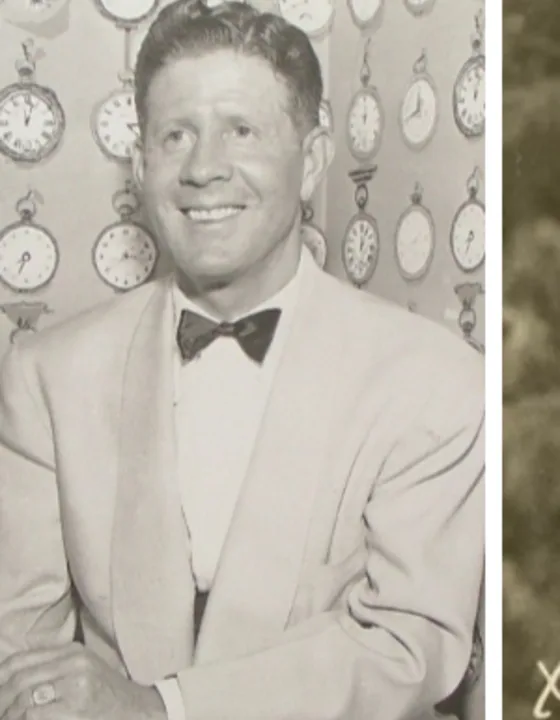
Rudy Vallée was not the kind of entertainer who collected trophies in a trophy room. His recognition came in harder-to-frame forms — cultural dominance, institutional firsts, and a career that outlasted most of his contemporaries by decades. From the late 1920s through the 1960s, Vallée accumulated a body of work that earned him formal honors, industry acknowledgment, and a permanent place in American entertainment history.
Star on the Hollywood Walk of Fame
Rudy Vallée holds a star on the Hollywood Walk of Fame at 6254 Hollywood Boulevard, in the Radio category. The designation is specific: Radio, not Film or Recording. This matters because it reflects exactly where Vallée's cultural authority was rooted — in the microphone, not the marquee.
At the time of his emergence, radio was not simply a medium. It was the primary way Americans encountered popular music, and Vallée was among the first performers to understand how to use it. His star is one of the early recognitions that acknowledged radio personalities as cultural figures on par with film stars.
Recognition as a Pioneer of American Radio Broadcasting
Vallée's most enduring institutional recognition is his identification as one of the architects of American radio entertainment. His NBC program, The Fleischmann's Yeast Hour (later The Royal Gelatin Hour), ran from 1928 to 1939 — eleven years of weekly national broadcasting that made him the first true radio star in the modern sense.
What that program accomplished:
- It established the variety format that would define broadcast entertainment for the next three decades
- It introduced dozens of performers to national audiences, including Edgar Bergen, Alice Faye, and Joe Penner
- It demonstrated that a single performer could anchor a weekly broadcast and build a loyal, measurable audience
- It created the template that shows like The Jack Benny Program and The Burns and Allen Show would follow
The Library of Congress and multiple radio history archives treat Vallée's broadcasts as primary source material for understanding how American popular culture transitioned from regional to national in the early 20th century.
Grammy Hall of Fame and Recording Recognition
Vallée's recordings have received archival and scholarly recognition that reflects their historical significance. His 1929 recording of "My Time Is Your Time" is one of the most cited early examples of a radio-identified signature song — a piece of music that functioned as both a performer's brand and a cultural artifact.
| Recording | Year | Significance |
|---|---|---|
| My Time Is Your Time | 1928/1929 | Signature radio theme; earliest example of a broadcast-linked identity song |
| Vagabond Lover | 1929 | Title song from his debut film; commercially successful |
| As Time Goes By | 1931 | Vallée recorded this before Casablanca made it famous |
| I'm Just a Vagabond Lover | 1929 | Tied to his public persona; widely circulated on early Victor Records releases |
The Grammy Hall of Fame has recognized recordings from the 1920s and 1930s era broadly, and Vallée's catalog remains a reference point in discussions of early electrical recording and commercial popular music.
Theatrical and Broadway Recognition
After his radio dominance, Vallée pivoted to Broadway and received significant industry recognition there. His performance in How to Succeed in Business Without Really Trying (1961) earned him a Tony Award for Best Featured Actor in a Musical.
This is one of the most concrete formal honors of his career. Vallée played J.B. Biggley, a pompous corporate executive — a role that required him to play against his own image. The production ran for 1,417 performances and won the Pulitzer Prize for Drama in 1962, making his involvement part of one of Broadway's most decorated productions of the 20th century.
Key facts about the Tony win:
- Category: Best Featured Actor in a Musical
- Year: 1962 (for the 1961-62 season)
- Production: How to Succeed in Business Without Really Trying
- Co-stars included Robert Morse, who won Best Actor for the same production
Vallée later reprised the Biggley role in the 1967 film adaptation, demonstrating that the recognition was tied to his genuine ownership of the character.
Honorary and Cultural Recognition in New England
Vallée was born Hubert Prior Vallée on July 28, 1901, in Island Pond, Vermont, and grew up in Westbrook, Maine. Maine claimed him as a native son throughout his career, and he received recognition from the state in multiple forms.
The city of Westbrook, Maine designated recognition of Vallée's cultural contributions. He maintained connections to the region throughout his life, and regional institutions — including those tied to the University of Maine, where he briefly studied — acknowledged his career as representative of what New England performers could achieve on the national stage.
His Ivy League education at Yale University (Class of 1927) added a specific credential to his public identity that was unusual among entertainers of his era. Yale's connection to Vallée is embedded in his public persona — he adopted the Yale Bulldogs' fight song "Bulldog" as part of his early repertoire and frequently referenced the university in public appearances.
Recognition from the Film Industry
Vallée's film career spanned from 1929 to the late 1960s, and while he was not primarily recognized by the Academy, several of his film contributions have been reassessed by archivists and film historians.
| Film | Year | Notes |
|---|---|---|
| The Vagabond Lover | 1929 | His film debut; preserved in discussions of early sound film |
| International House | 1933 | Ensemble film; recognized as a document of early 1930s popular culture |
| Palm Beach Story | 1942 | Preston Sturges film; critically reappraised; Vallée's performance cited in retrospectives |
| The Bachelor and the Bobby-Soxer | 1947 | Supporting role in Academy Award-winning film |
The Palm Beach Story deserves specific mention. Preston Sturges's screwball comedy is now considered one of the finest American comedies of the 1940s, and Vallée's performance as the earnest, wealthy John D. Hackensacker III has been praised in subsequent critical assessments. His work in that film represents recognition by association with a director and production that history has judged very well.
The "Vagabond Lover" Cultural Legacy
Beyond formal awards, Vallée earned a nickname that functioned as a cultural honor in its own right: the Vagabond Lover. The phrase came from his 1929 film and song, but it grew into something larger — a descriptor that identified a specific type of romantic, unhurried, college-educated American masculinity.
The cultural impact of that identity:
- Created the template for the "crooner" persona that Bing Crosby, Perry Como, and others would refine
- Established the megaphone as a performance prop with genuine stage presence
- Made the male vocalist a headliner rather than a supporting element in a dance band
Historians of American popular music treat Vallée's construction of this persona as a genuine contribution to entertainment — one that influenced the entertainment industry's understanding of what a male singing star could be.
Archival Recognition and Preservation Efforts
The Rudy Vallée Collection is held at the American Radio Archives in Thousand Oaks, California — one of the most significant repositories of American broadcast history. The collection includes scripts, correspondence, photographs, recordings, and memorabilia spanning his entire career.
This kind of archival recognition is distinct from awards but equally significant for understanding a performer's historical standing. Institutions collect what they believe will matter to future researchers. The scale of the Vallée archive reflects the professional and scholarly consensus that his career documents a pivotal period in American media history.
Additional archival material is held at:
- The Library of Congress (recorded performances and radio transcriptions)
- Yale University's Beinecke Library (personal correspondence, Yale-related materials)
- The Paley Center for Media (broadcast recordings and memorabilia)
Recognition for Introducing Other Performers
One of the less-formalized but historically significant aspects of Vallée's legacy is his role as a discoverer and promoter of other talent. His radio program functioned as a national platform at a time when no other equivalent existed.
Performers who received early national exposure through Vallée's broadcasts:
- Edgar Bergen and Charlie McCarthy
- Alice Faye
- Joe Penner
- Frances Langford
- Lou Costello (early appearances)
The music industry's understanding of what a host owes to the performers they platform is, in part, shaped by Vallée's model. He was recognized during his lifetime for this curatorial role — it was discussed in press coverage of his career and acknowledged by the performers themselves.