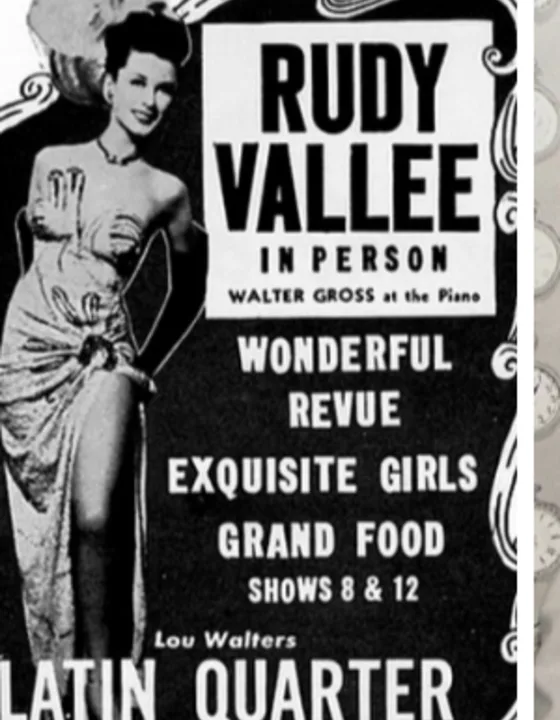
Rudy Vallée was the first American entertainer to become a mass-media celebrity before television existed. His career spanned vaudeville stages, NBC radio, Hollywood soundstages, and Broadway — and each phase left behind a distinct photographic record that historians and collectors still study today.
Why Archive Photos of Rudy Vallée Matter
Most photographs of Vallée dating from 1928 to 1955 exist in one of three forms: studio publicity stills commissioned by Paramount or RKO, wire-service press photos distributed to newspapers, and private candid shots held by estates or university archives. Each category tells a different story.
Publicity stills were carefully lit and retouched to project a specific image — in Vallée's case, the "Vagabond Lover" persona his label and studio built around his 1929 debut film. Press wire photos, by contrast, capture unscripted moments: radio rehearsals at NBC's 8H Studio in New York, appearances at the Café Lounge at the Hotel Heupel, or wartime USO performances during World War II.
Phases of Vallée's Career Captured on Film
His visual archive divides naturally into distinct periods, each with its own photographic style, format, and subject matter.
| Period | Approximate Dates | Dominant Photo Format | Primary Setting |
|---|---|---|---|
| Early Radio & Dance Bands | 1928–1932 | Glass-plate negatives, halftone prints | NBC studios, Heigh-Ho Club NYC |
| Hollywood Studio Era | 1929–1941 | 4x5 acetate sheet film | Paramount, RKO, Universal lots |
| Wartime & USO Tours | 1942–1945 | 35mm press film | Military bases, Pacific and European theaters |
| Broadway & Television | 1947–1961 | 35mm and medium format | Broadway houses, CBS/NBC TV studios |
| Late Career & Retrospective | 1962–1986 | Color 35mm, Polaroid | Talk shows, revival concerts |
The Heigh-Ho Club and Early Radio Images
The Heigh-Ho Club at the Hotel Heupel in New York City, where Vallée led the Connecticut Yankees beginning in 1928, is one of the least-photographed performance venues of the era — yet several dozen images survive. Most are half-plate prints made by staff photographers for promotional use. These show Vallée holding his bullhorn megaphone (a signature prop before microphones became standard), the band arranged in a crescent on a small stage, and early audience scenes that document what a 1929 Manhattan supper club actually looked like.
The megaphone photographs are particularly significant for music historians. Vallée adopted it not as a gimmick but out of acoustic necessity — early carbon microphones distorted at close range, and the megaphone allowed him to project to the room while staying far enough back. Images from 1928 show him angling it toward the NBC broadcast microphone, a detail that explains how remote radio pickups worked in the pre-condenser era.
Hollywood Studio Stills: Paramount and RKO
Between 1929 and 1936, Vallée appeared in eight films. The studio still photography from these productions is among the best-preserved material in his archive, largely because Paramount and RKO maintained systematic negative libraries that were later transferred to collections including the Academy of Motion Picture Arts and Sciences (AMPAS) Margaret Herrick Library in Beverly Hills.
Key films represented in surviving still sets include:
- The Vagabond Lover (1929) — RKO's first musical feature; stills show Vallée in character alongside Marie Dressler, with several behind-the-camera shots of director Marshall Neilan.
- International House (1933) — Paramount ensemble film; still sets include W.C. Fields, Bela Lugosi, and George Burns, making them cross-referenced in multiple collections.
- Gold Diggers in Paris (1938) — Warner Bros. production; Technicolor tests from this period exist as separate color still photographs, rare for the late 1930s.
- The Palm Beach Story (1942) — Preston Sturges direction; candid on-set photographs taken by Sturges's personal photographer document improvised blocking.
Studio stills were typically numbered with a production code stamped on the reverse, a detail that helps researchers date undated prints. A Paramount still reading "P-1933-IH-044" indicates it is the 44th image from the International House production in 1933.
Press Wire Photos and News Agency Archives
The Associated Press, Acme Newspictures (later absorbed into UPI), and Wide World Photos all covered Vallée extensively from the late 1920s through the 1950s. Their archives, now largely held by Getty Images and AP Images, contain thousands of captioned wire prints.
Wire photos differ from studio stills in a specific way: they carry editorial captions typed on paper slips glued to the reverse, often with date stamps, transmission codes, and the receiving newspaper's markings. A 1944 wire print showing Vallée in Coast Guard uniform at a war bond rally might carry markings from four different newspapers — evidence of how widely a single image circulated.
These captions are primary historical sources. They sometimes contain information not recorded elsewhere — the name of a band member, the city of a specific performance, or the reason for a public appearance.
Private and Estate Photographs
A third category is less accessible but often more revealing: photographs held privately or donated to university archives. Vallée himself was an active collector and archivist. Before his death in 1986, he donated personal papers and photographs to the American Antiquarian Society, Yale University (his alma mater), and the UCLA Film and Television Archive.
The Yale Beinecke Rare Book and Manuscript Library holds correspondence and some photographic material. The UCLA collection focuses on film-related documents. These institutional holdings include:
- Informal snapshots from the Connecticut Yankees tours of the early 1930s
- Personal photographs from Vallée's four marriages
- Behind-the-scenes images from Broadway productions including How to Succeed in Business Without Really Trying (1961), in which he played the pivotal role of J.B. Biggley
How to Access Rudy Vallée Photographs
Researchers and collectors have several legitimate access points, each with different costs and licensing terms.
| Source | Type of Material | Access Method | Typical Cost |
|---|---|---|---|
| AMPAS Margaret Herrick Library | Studio stills, publicity photos | In-person or digital request | Free to view; reproduction fee varies |
| Getty Images Archive | AP/Acme wire photos, some studio material | Online licensing | $250–$600 per editorial use |
| Library of Congress Prints & Photographs | Selected broadcast-era photos | Online via loc.gov | Free for non-commercial use |
| Yale Beinecke Library | Personal papers, some photographs | Research appointment | Free to view |
| UCLA Film & Television Archive | Film production stills | Research request | Varies by project |
| Auction houses (Heritage, Swann) | Vintage original prints | Public auction | $40–$800 per print depending on provenance |
Original vintage prints — meaning photographic prints made at the time of the event, not later reproductions — command a premium at auction. A signed Paramount studio still from the 1930s sold at Heritage Auctions in 2023 for $340. Unsigned but clearly dated wire prints from major events typically sell between $45 and $120.
Identifying Authentic Period Photographs
Not every image labeled "Rudy Vallée vintage photo" sold online is what it claims to be. Several markers distinguish period originals from later copy prints or digital reproductions printed on aged paper.
Authentic period markers to look for:
- Silver gelatin surface with slight sheen variation under raking light (later inkjet reproductions appear uniformly flat)
- Reverse-side markings in period typewriter font, including studio codes or wire service stamps
- Foxing or silver mirroring consistent with storage age, not applied artificially
- Print size consistent with format standards: 8x10 for studio stills, 7x9 for wire photos, 5x7 for fan club prints
Red flags:
- Overly uniform aging with no differential fading between highlight and shadow areas
- Digital fonts on captions or labels
- No reverse markings at all (very rare for commercial-era photographs)
- Resolution artifacts visible under 10x loupe
The Megaphone as Visual Symbol
Any serious collector or researcher working with Vallée's archive encounters the megaphone repeatedly. In photographs from 1928 to roughly 1935, it appears in nearly every stage image. After NBC standardized condenser microphones at its New York studios around 1932, it disappears from broadcast photos but occasionally reappears in stage and film contexts as a deliberate nostalgic callback.
The megaphone's presence or absence in an undated photo can therefore help narrow the date range. Images showing both a megaphone and a visible RCA microphone on the same stand likely date from 1930–1932, the transition period when both technologies were in simultaneous use.
Condition Grading for Collectors
Collectors use a working condition scale adapted from the cinema poster and baseball card markets.
| Grade | Description | Typical Market Adjustment |
|---|---|---|
| Excellent (EX) | No tears, minimal corner wear, clean reverse | Full market value |
| Very Good (VG) | Minor corner bumps, light handling marks | 15–25% below EX |
| Good (G) | Visible creases, some staining, intact image | 40–60% below EX |
| Fair (F) | Significant damage, writing on image area | 70%+ below EX |
| Poor (P) | Major tears, missing sections | Collectible mainly for rare subjects |
Condition matters less when the subject or context is exceptionally rare — a candid photograph showing Vallée with George Gershwin, for example, would command a premium regardless of moderate condition issues.