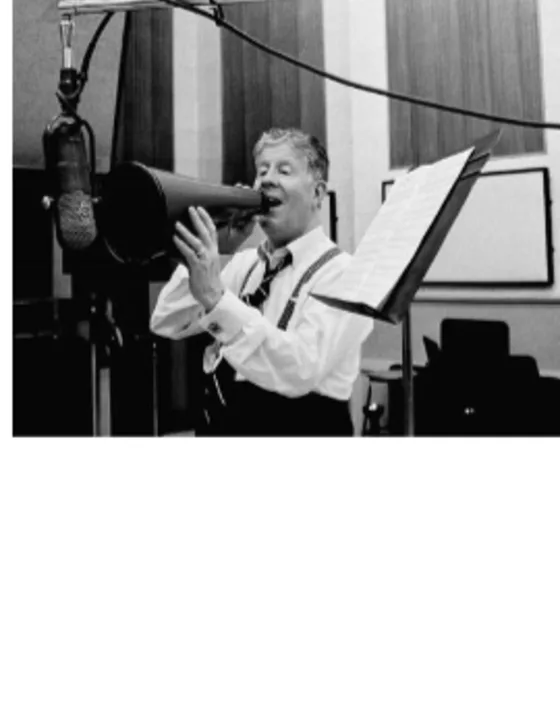
Rudy Vallée was one of the first American entertainers to become a genuine mass-media phenomenon, built on radio rather than records or film. His career stretched from the early 1920s through the 1970s, crossing vaudeville, network radio, Hollywood studio films, and Broadway — a span that few performers of his generation matched.
Early Life and Childhood (1901–1919)
Hubert Prior Vallée was born on July 28, 1901, in Island Pond, Vermont, to Charles Alphonse Vallée and Katherine Agnes Lynch. His father ran a pharmacy, and the family relocated to Westbrook, Maine, when Rudy was a child. That move placed him in a mid-sized New England town during the height of the band era, when live music filled dance halls on weekends.
Key facts from his early years:
- Adopted the name "Rudy" as a tribute to saxophonist Rudy Wiedoeft, whose recordings he studied obsessively
- Taught himself to play the drums before switching to saxophone and clarinet
- Worked as a movie theater musician in his teens, playing accompaniment for silent films
- Enlisted briefly in the U.S. Navy at age 16 by falsifying his age — he was discharged when the truth surfaced
By 1917 he was already performing locally, demonstrating an instinct for self-promotion that would define the next five decades.
University Years and First Bands (1920–1927)
Vallée attended the University of Maine briefly, then transferred to Yale University, where he graduated in 1927 with a degree in philosophy. Yale gave him two things: a veneer of Ivy League respectability that was unusual for popular musicians of the era, and a natural audience.
| Year | Event |
|---|---|
| 1921 | Studied at the University of Maine |
| 1922 | Transferred to Yale University |
| 1924 | Spent a year at the University of London, performing in clubs |
| 1925 | Returned to Yale; began leading campus dance bands |
| 1927 | Graduated from Yale; moved to New York City |
His year in London, 1924–1925, was formative. He worked with professional British dance orchestras and absorbed arrangements that American college bands had not yet adopted. When he returned to New Haven, his playing level had jumped noticeably above his peers.
New York Breakthrough and the Connecticut Yankees (1928–1929)
Moving to New York City after graduation, Vallée assembled a group he named the Connecticut Yankees — a deliberate reference to his New England roots and Yale identity. The band secured a residency at the Heigh-Ho Club on East 53rd Street in January 1928.
Within weeks, a local radio station began broadcasting live sets from the club. The response was immediate. Vallée's light, almost conversational tenor voice — combined with his habit of cupping his hands around a megaphone when singing — created an intimate, close-mic quality that translated differently on radio than the projecting voices audiences expected in theaters.
What made Vallée's radio sound distinctive in 1928:
- Megaphone technique reduced distortion on early carbon microphones
- Conversational phrasing contrasted sharply with operatically trained contemporaries
- Song selection leaned toward romantic ballads rather than novelty numbers
- Live broadcast format meant no post-production polish — audiences heard the room
NBC signed the Connecticut Yankees for national broadcast before the end of 1928. The Fleischmann's Yeast Hour debuted on NBC on October 24, 1929 — one of the first sustained variety programs on American radio.
Radio Stardom and the Fleischmann's Yeast Hour (1929–1939)
The Fleischmann's Yeast Hour ran for a decade and established Vallée as what Billboard would later describe as the first true radio star — an entertainer whose fame originated in broadcasting rather than performance venues. Listener mail to NBC regularly exceeded 10,000 letters per week during peak years.
The show's format was significant for several reasons beyond Vallée himself. He used the program to introduce emerging talent to national audiences at a time when geographic and industry barriers kept regional performers from reaching New York bookers.
Performers introduced or given major national exposure on the Fleischmann's Yeast Hour:
- Alice Faye
- Edgar Bergen and Charlie McCarthy
- Joe Penner
- Kate Smith (early major appearances)
- Bob Burns
The program ran every Thursday evening, 8:00 to 9:00 PM Eastern, through 1939. Sponsors changed after Fleischmann's Yeast, but the format remained consistent: comedy sketches, Vallée vocal performances, and a guest spotlight.
Hollywood Films and the Studio Era (1929–1945)
Paramount signed Vallée quickly once his radio numbers confirmed audience scale. His first film, The Vagabond Lover (1929), cast him essentially as a fictionalized version of himself — a bandleader who becomes famous. The film is historically notable as an early sound production and as a document of the megaphone era before close-mic crooning became standard.
| Film | Year | Studio | Notes |
|---|---|---|---|
| The Vagabond Lover | 1929 | RKO | Feature debut, early sound film |
| International House | 1933 | Paramount | Ensemble comedy, W.C. Fields |
| George White's Scandals | 1934 | Fox | Musical revue format |
| Sweet Music | 1935 | Warner Bros. | Co-starred Ann Dvorak |
| The Palm Beach Story | 1942 | Paramount | Preston Sturges film, comic supporting role |
| Happy Go Lucky | 1943 | Paramount | Musical comedy |
| It's in the Bag | 1945 | United Artists | Ensemble comedy |
The Palm Beach Story (1942) represented a genuine shift in how Vallée was used on screen. Director Preston Sturges cast him as J.D. Hackensacker III, a fussy, eccentric millionaire — a self-deprecating role that Vallée played with precision. Critics who had dismissed him as a lightweight noted the performance specifically.
Military Service and Decline of Radio Era (1942–1947)
Vallée re-enlisted after Pearl Harbor and was commissioned as a lieutenant commander in the U.S. Coast Guard Reserve. He led the 11th District Coast Guard Band in Los Angeles, producing wartime morale programming and recruiting drives.
The radio landscape he returned to after the war had changed structurally. Television was absorbing advertiser budgets. The crooner format had been absorbed and amplified by Frank Sinatra, whose Capitol Records contract and Capitol Tower studio sound operated on a different technical level than anything from 1929. Vallée continued recording and performing but without the same infrastructure.
Broadway Return and How to Succeed in Business (1961)
The most surprising chapter of Vallée's later career was theatrical. In 1961, he was cast as the pompous corporate executive J.B. Biggley in Frank Loesser's How to Succeed in Business Without Really Trying. The show ran 1,417 performances on Broadway. Vallée did not play the lead — that was Robert Morse — but his role was substantial, and his willingness to satirize his own patrician image gave the production a layer of comedic authenticity.
He reprised the role in the 1967 film adaptation.
This period demonstrated something the Fleischmann's decade had suggested but not confirmed: Vallée was a skilled comic actor, not simply a singer who appeared in films.
Recordings and Discography Overview
Vallée recorded for multiple labels across five decades. Early sessions were acoustic or early-electric. By the 1930s he was recording with full studio orchestras.
Primary recording periods by label:
| Decade | Primary Labels | Format |
|---|---|---|
| 1920s | Columbia, Victor | 78 rpm |
| 1930s | Victor, ARC/Brunswick | 78 rpm |
| 1940s | Decca, Capitol | 78 rpm |
| 1950s | X Records, various | 78 rpm / early LP |
| 1960s–70s | Various reissue labels | LP |
Notable recordings include Vagabond Lover (1929), as a signature song, and his covers of Brother, Can You Spare a Dime? and As Time Goes By. The Vagabond Lover track is catalogued in the Library of Congress National Recording Registry as a document of early electrical recording practice.
Later Years and Legacy (1968–1986)
Vallée remained visible through the 1960s and 1970s in television appearances, including guest slots on variety programs that used his presence as a link to old Hollywood rather than as a current performer. He appeared on The Tonight Show multiple times and gave extended interview sessions to radio archivists documenting the early network era.
He published two memoirs: Vagabond Dreams Come True (1930) and Let the Chips Fall (1975). The second book is the more useful historical document, covering the radio industry from an insider's perspective during the transition from acoustic to electric broadcasting and from radio to television.
Vallée died on July 3, 1986, in North Hollywood, California, 25 days before what would have been his 85th birthday.