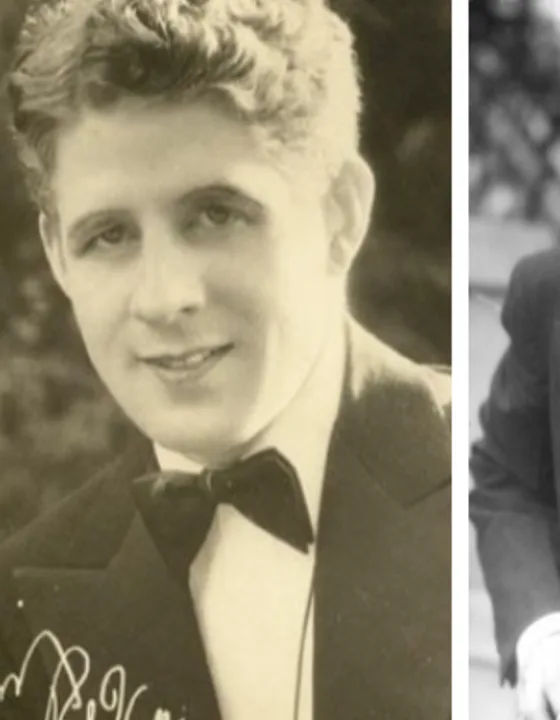
Rudy Vallée did not just sing — he rewired how Americans consumed music. Before television, before the album era, before anyone used the word "celebrity" the way we do now, Vallée built a national fan base through radio and a megaphone. He was the first performer whose voice alone could cause women to faint in theater aisles, a full decade before Frank Sinatra tried the same trick.
Who Was Rudy Vallée
Hubert Prior Vallée was born on July 28, 1901, in Island Pond, Vermont. He adopted the stage name "Rudy" as a nod to his idol, saxophonist Rudy Wiedoeft. His family moved to Westbrook, Maine, where he grew up and developed an early obsession with the C-melody saxophone — practicing obsessively rather than treating music as a hobby.
He studied at the University of Maine and later transferred to Yale University, graduating in 1927 with a degree in philosophy. Yale gave him more than a diploma: it gave him a band name. His group, the Connecticut Yankees, became his primary vehicle for the next decade.
Early Career: Yale, London, and the First Breaks
Before finishing at Yale, Vallée spent a year in London in 1924, playing with the Savoy Havana Band. That European stint exposed him to a more disciplined approach to performance and arrangement — something that separated the Connecticut Yankees from the rougher American dance bands of the period.
Key early milestones:
- 1924 — performs with Savoy Havana Band, London
- 1927 — graduates Yale, forms Rudy Vallée and His Connecticut Yankees
- 1928 — opens at the Heigh-Ho Club, New York City
- 1928 — signs with NBC radio; "The Fleischmann's Yeast Hour" begins
The radio deal was the turning point. NBC gave him a weekly national platform at a time when radio sets were appearing in American living rooms by the millions.
Radio and the Megaphone: How Vallée Changed Pop Music
The megaphone was not a gimmick. Early microphones distorted low-frequency vocals and rewarded loud, operatic singers. Vallée used a cardboard megaphone to shape his voice for the room while maintaining an intimate, conversational tone — something no other performer had systematized before him.
"The Fleischmann's Yeast Hour" (later renamed "The Rudy Vallée Show") ran from 1929 to 1939 on NBC. At its peak, it reached an estimated 15 to 20 million listeners per broadcast. For context, the entire US population in 1930 was 123 million. He was simultaneously a DJ, a bandleader, a host, and a star — roles that did not yet have separate names.
What the show introduced to American radio:
| Innovation | Details |
|---|---|
| Guest booking at scale | Vallée introduced Edgar Bergen, Alice Faye, and Bob Hope to national radio audiences |
| Crooner format | Intimate vocal delivery replacing vaudeville projection |
| Sponsored variety structure | Format later copied by virtually every prime-time radio show |
| Live band integration | Full orchestra as part of the broadcast, not background filler |
His signature opening — "Heigh-ho, everybody!" — became one of the first catchphrases in broadcast history.
Hit Songs and Recording Career
Vallée recorded prolifically between 1928 and the early 1940s. He worked with Victor Records and then Columbia, producing dozens of charting sides during the 78 rpm era.
Selected recordings that defined his catalog:
- "My Time Is Your Time" (1929) — became his theme song; he used it for the rest of his career
- "I'm Just a Vagabond Lover" (1929) — title became his unofficial nickname
- "As Time Goes By" (1931) — Vallée recorded this song 12 years before Casablanca made it famous
- "You Ought to Be in Pictures" (1934)
- "The Whiffenpoof Song" (1937) — closely associated with his Yale identity
His vocal approach was closer to speech than to classical singing: he relied on breath control and mic technique rather than pure volume. That intimacy was the product, not an accident.
Film Career: Hollywood in the 1930s and Beyond
Vallée transitioned to film with more success than most bandleaders of his era. His screen debut came in 1929 with "The Vagabond Lover," a film built entirely around his radio persona. It was a commercial success, though critics noted even then that his acting range was narrow.
The more interesting film chapter came later. After his musical stardom faded in the early 1940s — displaced by Sinatra, Crosby, and the swing era — Vallée reinvented himself as a comic character actor.
Film and television highlights by decade:
| Decade | Notable Work | Role Type |
|---|---|---|
| 1930s | The Vagabond Lover, Gold Diggers in Paris, Sweet Music | Musical lead |
| 1940s | Palm Beach Story (1942), Happy Go Lucky (1943) | Comic supporting |
| 1950s | Gentlemen Marry Brunettes (1955) | Character actor |
| 1960s | How to Succeed in Business Without Really Trying (1967) | Scene-stealing comic lead |
"How to Succeed in Business Without Really Trying" deserves specific mention. Vallée originated the role of J.B. Biggley on Broadway in 1961, won a Tony Award, and reprised it in the 1967 film. Critics who had written him off as a period novelty were forced to reassess. He was 65 years old during filming and commanded every scene he appeared in.
Personal Life
Vallée married four times. His most public relationship was his marriage to actress Jane Greer, which lasted from 1943 to 1944 and ended quickly enough that both parties avoided discussing it in detail afterward.
His longest marriage was to Eleanor Norris, whom he married in 1949. She remained his partner until his death and is credited by people close to him as the stabilizing force in his later decades.
He was known for being meticulous, litigious, and difficult to work with. Multiple collaborators and ex-partners ended up in court disputes with him. He kept extraordinarily detailed personal records — diaries, contracts, correspondence — much of which now forms the basis of archival research into 1930s entertainment.
Military Service and World War II
Vallée enlisted in the United States Coast Guard in 1942 at age 40, serving as a Chief Petty Officer and directing the 11th Naval District Coast Guard Band in San Diego. He did not see combat but organized recruitment concerts and radio broadcasts for the war effort.
His military service coincided with the natural decline of his first career peak. By the time he returned to civilian entertainment, the musical landscape had shifted entirely — bebop, Sinatra's solo dominance, and the collapse of the big band economy had restructured everything.
Why Vallée Matters to Music History
The instinct is to file Vallée under "nostalgia" and move on. That instinct is wrong, for specific reasons:
1. He established the template for the pop vocal star — a single named performer fronting an anonymous backing unit, with a radio show as the primary promotional vehicle. 2. He demonstrated that recorded intimacy could replace theatrical projection — a shift that made nearly every subsequent style of popular singing possible. 3. He introduced or launched the careers of more than a dozen performers who later became major stars, including Bob Hope and Alice Faye. 4. His longevity — commercially active from 1928 to the late 1960s — is nearly unmatched for a performer who began in the pre-microphone era.
The comparison most music historians reach for is Elvis Presley in 1956: a performer whose effect on an audience was physically disruptive. Vallée produced that reaction in 1929, with acoustic technology and a cardboard cone.
Later Years and Death
Through the 1970s and into the 1980s, Vallée made occasional television appearances, gave interviews, and continued to defend his legacy publicly and sometimes aggressively. He published two memoirs: "Vagabond Dreams Come True" (1930) and "Let the Chips Fall" (1975). The second book is the more useful document — it is candid, occasionally bitter, and contains more useful detail about the entertainment industry of the 1930s than most academic histories.
He died on July 3, 1986, in North Hollywood, California, 25 days before what would have been his 85th birthday. He was inducted into the Big Band and Jazz Hall of Fame and is commemorated in Westbrook, Maine, where the Rudy Vallée Museum preserves recordings, photographs, and personal artifacts.