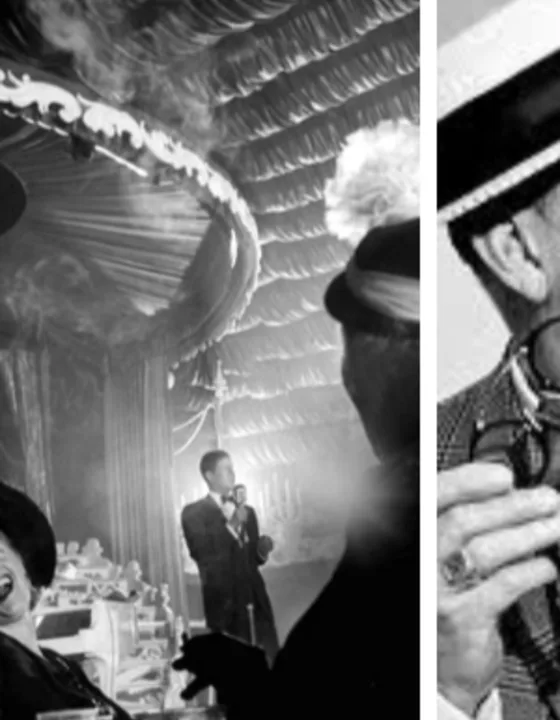
Rudy Vallée arrived in Hollywood not because he was a trained actor but because he was already one of the most famous voices in America. His radio broadcasts on NBC had built an audience that studios wanted on screen, and by 1929 Paramount was ready to put him in front of a camera. What followed was a film career that stretched across five decades and shifted from romantic lead to comic character actor — a range few entertainers of his generation managed.
How Rudy Vallée Got to Hollywood
Vallée's path to film was driven by the commercial logic of early sound cinema. Studios needed performers audiences already recognized by voice, and Vallée's megaphone-era crooning had made him a national phenomenon before he turned 30. Paramount signed him quickly, and his first feature went into production while his radio show was still pulling record listener numbers.
His screen persona in the early years was essentially an extension of his stage act: the Yale-educated bandleader with a slightly nasal tenor and an air of affable confidence. That image worked well for musical shorts and light comedies but became a limitation once romantic-lead fashions shifted in the mid-1930s.
Early Sound Era Films (1929–1935)
Vallée's first Hollywood period was built around the musical-revue format that studios used heavily in the early sound transition. These productions were designed to showcase talent rather than tell complex stories, which suited Vallée's strengths.
| Year | Title | Studio | His Role | Notes |
|---|---|---|---|---|
| 1929 | "The Vagabond Lover" | RKO | Rudy Bronson | Feature debut; written around his bandleader persona |
| 1929 | "Glorifying the American Girl" | Paramount | Himself | Cameo in Ziegfeld revue film |
| 1930 | "International House" | Paramount | Himself | Ensemble musical comedy; shared billing with W.C. Fields |
| 1932 | "Campus Sweethearts" | Universal | Himself | Short subject; collegiate setting |
| 1933 | "George White's Scandals" | Fox | John Howard | Dramatic role embedded in musical revue format |
| 1934 | "Sweet Music" | Warner Bros. | Story credit / performer | One of his last romantic-lead features |
"The Vagabond Lover" is the most historically significant film from this period. It was shot at RKO's Pathé studios in Culver City, released in November 1929, and essentially asks the audience to watch Vallée play a fictionalized version of himself. Reviews at the time were mixed on the acting but positive on the musical numbers. The film did well enough commercially to confirm that his radio fame translated to ticket sales.
"International House" (1933, Paramount) is the more watchable picture today. W.C. Fields, Burns and Allen, and Cab Calloway share the screen, and Vallée appears as himself in a broadcast segment. It functions as a time capsule of early-1930s entertainment culture rather than a conventional narrative film.
The Transition Years (1936–1940)
By the mid-1930s, the romantic-lead market had moved toward performers like Clark Gable and Cary Grant, and Vallée's screen career slowed. He continued working in radio and recording, but his film output dropped sharply. The few pictures he made during this period were secondary productions.
This gap is worth noting because it is sometimes misread as a career failure. It was not. Vallée's radio audience remained enormous through the late 1930s, and his earnings from broadcasting and personal appearances far exceeded what most film actors made per year. Film was one revenue stream among several, not his primary platform.
The Preston Sturges Years (1941–1944)
The most critically important chapter of Vallée's film career began when Preston Sturges cast him in "The Palm Beach Story" in 1942. Sturges had a specific idea: Vallée's slight stiffness, his patrician accent, and his residual image as the earnest bandleader-crooner could be played for comedy. The result was one of the best performances of Vallée's career.
| Year | Title | Director | His Role | Character Type |
|---|---|---|---|---|
| 1941 | "Too Many Blondes" | Thornton Freeland | Himself | Cameo/musical |
| 1942 | "The Palm Beach Story" | Preston Sturges | John D. Hackensacker III | Comic lead; naive millionaire |
| 1943 | "Happy Go Lucky" | Curtis Bernhardt | Wally Case | Supporting musical comedy |
| 1944 | "It's in the Bag!" | Richard Wallace | Himself | Ensemble comedy cameo |
As Hackensacker in "The Palm Beach Story," Vallée plays an absurdly wealthy, sweetly oblivious heir who falls for Claudette Colbert's character. The performance works because Vallée leans into the character's earnestness without winking at the audience. Sturges reportedly told him to play it completely straight, and that discipline is what makes the scenes land. The film is now considered one of the better American comedies of the 1940s, and Vallée's contribution is consistently cited by film historians.
Sturges used him again in "The Sin of Harold Diddlebock" (1947, produced by Howard Hughes), where Vallée has a smaller but structurally similar role — the wealthy, slightly dim establishment figure who exists to be outmaneuvered.
Mid-Career and Television Crossover (1945–1959)
After World War II, Vallée's film appearances became more occasional. He took supporting roles and cameos in a range of productions, some respectable, some purely commercial. His television work during this period was more consistent than his film work.
| Year | Title | Role Type | Notes |
|---|---|---|---|
| 1945 | "People Are Funny" | Supporting | Radio-to-film adaptation |
| 1947 | "The Sin of Harold Diddlebock" | Supporting | Final Sturges collaboration |
| 1954 | "Gentlemen Marry Brunettes" | Himself | United Artists musical |
| 1955 | "The Helen Morgan Story" | Supporting | Warner Bros. biographical film |
By the mid-1950s, Vallée was doing more television than film. He appeared on variety programs and early comedy-drama formats, which kept him in the public eye but produced fewer archivable screen credits than his earlier studio work.
Late Career: Character Actor Period (1960–1978)
The final phase of Vallée's screen career is underappreciated. He found a second wind as a character actor in the 1960s and 1970s, playing versions of the pompous, self-important establishment figure — a type he had refined with Sturges and could now deploy across different genres.
| Year | Title | Studio / Network | Role | Genre |
|---|---|---|---|---|
| 1966 | "How to Succeed in Business Without Really Trying" | United Artists | J.B. Biggley | Musical comedy; repeated his Broadway role |
| 1967 | "The Night They Raided Minsky's" | United Artists | Charles Dillingham | Period comedy-drama |
| 1968 | "Live a Little, Love a Little" | MGM | Supporting | Elvis Presley vehicle |
| 1970 | "The Phynx" | Warner Bros. | Himself | Ensemble |
| 1976 | "Won Ton Ton, the Dog Who Saved Hollywood" | Paramount | Cameo | Hollywood nostalgia ensemble |
"How to Succeed in Business Without Really Trying" is the standout from this period. Vallée had played J.B. Biggley on Broadway starting in 1961, and when United Artists adapted the musical for film in 1966, he reprised the role. The character — a complacent corporate executive who is easily manipulated — fit Vallée's late-career screen persona precisely. He received positive notices, and the film performed well commercially.
The casting in "The Night They Raided Minsky's" shows how directors in the late 1960s were using Vallée's historical associations deliberately. A performer who had actually been present in 1920s and 1930s entertainment culture brought authenticity to period productions that no younger actor could replicate.
What the Filmography Tells Us
Looking at Vallée's complete screen work as a body, three things stand out.
First, his best film performances came from directors who understood how to use his specific qualities rather than fighting them. Sturges is the clearest example: he converted Vallée's residual stiffness into a comic instrument.
Second, the gap between his radio influence and his film reputation has never fully closed. Historians working primarily from film records consistently underrate him because his most powerful cultural moments — the NBC broadcasts, the live performances — left no equivalent archive. His filmography is a partial record of his career, not a complete one.
Third, the character-actor phase from 1961 onward was more artistically productive than the early romantic-lead period. Vallée at 60 was a more interesting screen presence than Vallée at 29, which is not the typical trajectory for performers who entered film as music-industry celebrities.
Rudy Vallée on Screen: Format and Availability
Most of Vallée's pre-1934 films survive in some form. "The Vagabond Lover" is held at the Library of Congress. "International House" is available through home video and streaming archives. Several of the early shorts exist only as 16mm prints in private collections or regional film archives.
The Sturges films are the best-preserved and most accessible portion of the filmography. "The Palm Beach Story" has been released in multiple restored editions and is the most reliable entry point for anyone approaching Vallée's screen work for the first time.
"How to Succeed in Business Without Really Trying" (1966) is available in standard definition through several streaming platforms and in physical media editions from MGM's catalog.