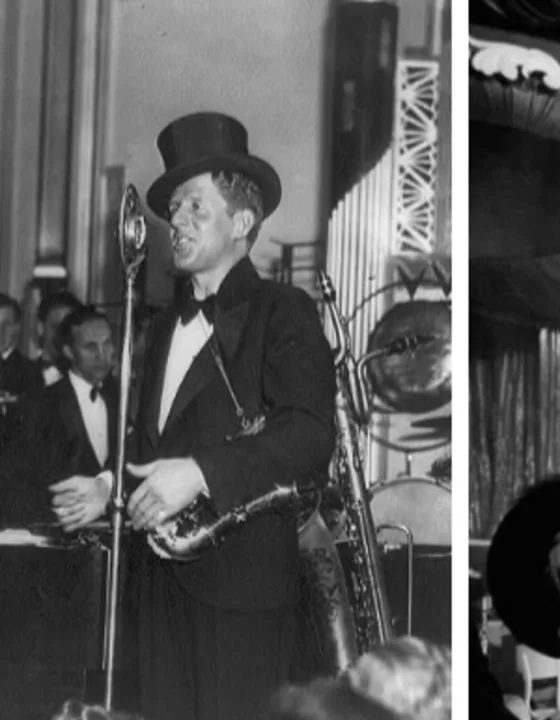
Rudy Vallée was born on July 28, 1901, in Island Pond, Vermont, a small railroad town near the Canadian border. His family moved to Westbrook, Maine when he was a child, and it was there that he first encountered music, radio, and the saxophone — the combination that would define his career. Long before he became a household name on NBC radio, he was a self-taught musician working through high school gigs and a brief stint in the U.S. Navy.
Birth, Family, and Childhood in Maine
Hubert Prior Vallée — the name Rudy came later, borrowed from saxophonist Rudy Wiedoeft — was the second child of Charles Alphonse Vallée and Katherine Agnes Lynch. His father ran a drugstore in Westbrook, Maine, which placed the family solidly in the working middle class. The town had about 8,000 residents at the time, a Franco-American community with deep roots in textile manufacturing.
Key facts about his early years:
- Born: July 28, 1901, Island Pond, Vermont
- Moved to Westbrook, Maine: circa 1905
- Father's occupation: pharmacist
- Ethnic background: French-Canadian and Irish
- Adopted nickname "Rudy" after Rudy Wiedoeft, a popular recording saxophonist of the 1910s
His father's drugstore stocked phonograph records, which gave the young Vallée access to recorded music at a time when most households had none. He credited those early listens — particularly dance band recordings — with shaping his sense of rhythm and phrasing.
The Saxophone and Self-Teaching
Vallée became obsessed with the saxophone in his early teens after hearing Rudy Wiedoeft's recordings. He taught himself from instructional pamphlets and by copying what he heard on records, a common path for musicians before formal jazz education existed. By age 15 he was playing local dances in the Portland-area circuit.
His approach was methodical. He kept practice logs, analyzed recordings phrase by phrase, and deliberately modeled his embouchure on Wiedoeft's tone. This early habit of systematic self-improvement carried forward into how he later approached vocal arranging and bandleading.
| Instrument | When started | Method | Influence |
|---|---|---|---|
| Saxophone | ~1914, age 13 | Self-taught from records and pamphlets | Rudy Wiedoeft |
| Vocals | Early 1920s | Developed alongside sax work | British dance bands heard in London |
| Megaphone technique | Mid-1920s | Adapted from vaudeville practice | Pre-microphone necessity |
U.S. Navy Service
In 1917, at 16, Vallée lied about his age and briefly enlisted in the U.S. Navy. He was discharged when his true age was discovered — the episode lasted only weeks. He re-enlisted legitimately in 1918 and served until the armistice ended World War I in November of that year.
His time in the Navy had practical musical consequences: he played in military bands, gained experience performing for large groups, and encountered musicians from different regions of the country. It also introduced him to the discipline of rehearsal schedules, which later made his professional bands notably tight by 1920s standards.
University of Maine and the Decision to Transfer
After the Navy, Vallée enrolled at the University of Maine in 1921. He played in the university band and continued gigging locally. But Maine's music scene had limits, and he was ambitious. A key turning point came when he heard about Yale University's prestige and the social connections available through its musical clubs.
He transferred to Yale in 1922. The decision was partly pragmatic: Yale had a stronger network, better access to New York booking agents, and a culture of theatrical performance through its Dramatic Association and Glee Club. His grades were adequate but unremarkable — what Yale gave him was exposure, not academics.
Yale University: 1922–1927
Vallée spent more years at Yale than the standard four-year degree required, largely because he interrupted his studies to perform and study abroad. He eventually graduated in 1927 with a degree in philosophy.
At Yale he:
- Joined the Yale Collegians, a student dance band
- Performed at college mixers throughout New England
- Built early relationships with booking contacts in New York
- Developed the polished, intimate vocal delivery that later translated well to radio microphones
The Yale environment shaped his image as much as his music. The association with Ivy League culture gave him a marketable persona: educated, accessible, slightly patrician — different from the rougher-edged jazz musicians of the period. He leaned into this deliberately, understanding that his audience skewed toward middle-class listeners who wanted sophistication without difficulty.
London and the Savoy Hotel, 1924–1925
One of the least-discussed chapters of Vallée's formation is his time in London. He took a leave from Yale in 1924 to play saxophone at the Savoy Hotel with the Savoy Havana Band. This engagement lasted approximately one year.
The London period mattered for several reasons:
1. British dance bands of the early 1920s were more disciplined and arrangement-focused than American equivalents 2. He observed how bandleaders like Jack Hylton managed performance, presentation, and audience communication 3. He encountered a transatlantic style of popular singing — less shouting, more intimate — that he brought back to the United States 4. The professional context was more demanding than college gigs; it required consistency eight nights a week
The Savoy Havana Band was one of the most recorded British dance bands of the era. Playing in that environment gave Vallée a standard of professional execution he had not encountered in Maine or at Yale. When he returned to the U.S. in 1925, the gap between his skill level and that of most college-circuit musicians had widened substantially.
Developing the Crooner's Vocal Approach
Vallée did not start as a vocalist. He was a saxophonist who began singing as a practical solution: sometimes the band's singer was unavailable, and Vallée could hold a melody. His voice was a light, reedy tenor — not powerful by any measure, which is why the megaphone and, later, the microphone suited him so precisely.
Before electrical recording became standard (roughly 1925–1926), singers had to project physically. Vallée's voice was not built for that. The arrival of the carbon microphone and electrical amplification in broadcasting essentially created the conditions under which his voice became viable — and then dominant.
His phrasing drew on:
- Saxophone breath control (longer phrases without breaks)
- British dance band restraint (no oversinging)
- Vaudeville timing (understanding of audience expectation)
- Personal affect — the slightly nasal, conversational tone that felt intimate through a radio speaker
By the time he formed his own band in 1928, the Connecticut Yankees, all of these elements were in place.
The Megaphone Years
Before his radio breakthrough, Vallée performed at clubs using a large cardboard megaphone to project his voice. The megaphone became a visual trademark — and a practical tool. At venues like the Heigh-Ho Club in New York (where he began his residency in 1928), the room acoustics required either a powerful voice or amplification. He chose amplification.
The image — young man in a tuxedo, holding a megaphone, singing to a packed supper club — was photographed widely in 1928 and 1929 and established the visual language of the crooner before the word "crooner" entered common use.
What the Early Life Explains About the Career
The biographical thread from Island Pond to Yale to London to the Heigh-Ho Club is not incidental. It explains several things about what Vallée did and how he did it:
| Formative experience | Career consequence |
|---|---|
| Druggist father's record stock | Early access to commercial recordings; developed listening as a skill |
| Self-teaching the saxophone | Systematic approach to craft improvement |
| U.S. Navy bands | Experience performing for non-voluntary audiences; rehearsal discipline |
| Yale network | Access to New York booking agents; middle-class audience identification |
| Savoy Havana Band, London | Professional execution standard; intimate vocal style |
| Megaphone performance | Visual persona; translation to microphone broadcasting |
He was not discovered. He constructed a path with deliberate choices at each stage: the transfer to Yale, the London engagement, the return to New York, the residency format rather than touring. When the NBC radio opportunity came in 1928 with The Fleischmann's Yeast Hour, he had already spent fifteen years preparing for it.