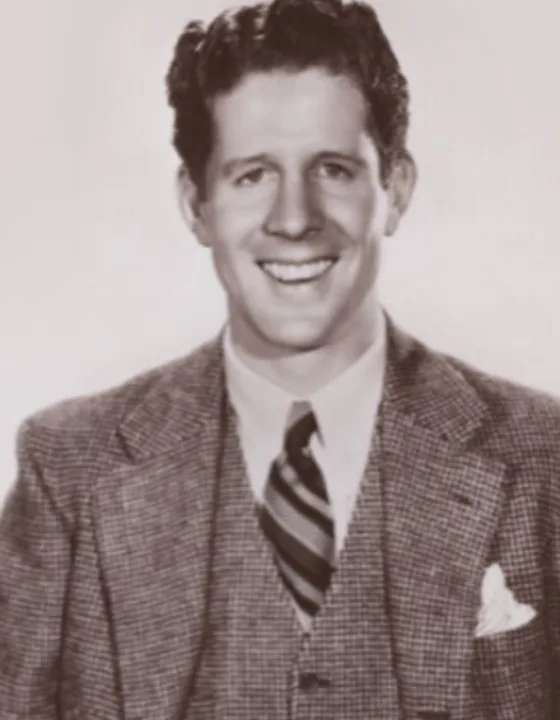
Rudy Vallée did not become famous by accident. Between 1928 and 1934, he transformed from a dance-band sideman into the most recognized voice on American radio — before television existed, before albums dominated culture, and before the word "celebrity" meant what it means today. His ascent was fast, deliberate, and built on a medium nobody had fully figured out yet.
Who Was Rudy Vallée Before the Fame
Hubert Prior Vallée was born July 28, 1901, in Island Pond, Vermont. He adopted the name "Rudy" as a tribute to Rudy Wiedoeft, the saxophone virtuoso he obsessively studied as a teenager.
Key biographical facts before his breakthrough:
- Grew up in Westbrook, Maine; father ran a pharmacy
- Taught himself clarinet and C-melody saxophone from recordings
- Enrolled at the University of Maine, then transferred to Yale University (Class of 1927)
- Studied in London at the Royal Academy of Music, 1924–1925
- Played in dance bands across New England and New York to pay tuition
Yale was not just a credential. It gave Vallée a bandleader platform. He formed the Yale Collegians while still a student, which became the direct predecessor to his professional ensemble.
The Yale Collegians and the Connecticut Yankees
After graduating from Yale, Vallée renamed his group the Connecticut Yankees. The choice was strategic — it signaled regional identity and played on nostalgia for the Ivy League at a time when college culture carried enormous social prestige.
The Connecticut Yankees' instrumentation in 1927–1928:
| Instrument | Notes |
|---|---|
| Saxophone (lead) | Vallée performed as front man |
| Trumpet | Typical hot jazz-era lineup |
| Trombone | Standard dance band configuration |
| Piano | Rhythm section anchor |
| Drums | Kept the foxtrot tempo |
| Violin | Added sweet-band texture |
The band secured a residency at the Heigh-Ho Club in Manhattan in late 1927. The venue was small, but the booking would change everything within months.
The Heigh-Ho Club and the Radio Breakthrough
The Heigh-Ho Club engagement started as a standard dinner-dance gig. Then NBC affiliate WABC offered remote broadcast time from the club floor.
In January 1928, Vallée began broadcasting live on radio. He opened every broadcast with a megaphone — an old vaudeville tool — and the phrase "Heigh-Ho, everybody!" The megaphone gave his voice a nasal, intimate quality that translated unusually well to early radio receivers, which had poor dynamic range and rewarded voices that sat in the mid-frequency band.
The response was immediate and quantifiable:
- Fan mail began arriving within two weeks of the first broadcast
- NBC reported the show was receiving more listener letters than nearly any other program in early 1928
- Vallée was signed to a national network program by mid-1928
What made his voice work on radio when others did not: early carbon microphones and crystal radio sets lost bass frequencies. Vallée's light tenor, delivered close to the mic with restrained vibrato, cut through distortion that swallowed bigger, operatic voices.
The Fleischmann's Yeast Hour: First National Radio Stardom
In October 1929 — the same month as the stock market crash — Rudy Vallée launched "The Fleischmann's Yeast Hour" on NBC. It would run until 1939, making it one of the longest-sponsored variety programs of the network radio era.
What the show did that was new:
- Mixed musical performance with comedy sketches and guest interviews
- Introduced national audiences to performers who later became major stars
- Ran 60 minutes in prime time, setting a format template others copied
Guests Vallée introduced to national audiences through the program include Edgar Bergen, Bob Hope, Alice Faye, and Joe Penner. He functioned as a talent broker before the term existed in entertainment.
By 1929, Vallée was receiving an estimated 10,000 fan letters per week — a figure NBC used in press materials and that contemporary newspaper accounts corroborated.
Why the Megaphone Mattered Culturally
The megaphone was not a gimmick. Before electronic amplification became standard at live venues, bandleaders used them to project over orchestras. But Vallée carried his megaphone onto radio stages and into film sets, turning it into a signature prop.
The cultural effect:
- It signaled intimacy rather than distance — he appeared to sing toward one listener, not a crowd
- Fan magazines in 1928–1930 repeatedly described his style as "personal" and "like he's in the room"
- It influenced how Frank Sinatra and Perry Como later conceptualized microphone technique — singing to a person, not at an audience
Music historians credit Vallée with establishing the crooner template: soft dynamics, direct address, romantic lyric emphasis. He was doing this three years before Sinatra entered high school.
Film Career and Hollywood: 1929–1934
Vallée's transition to film was rapid once radio established his face as bankable. Paramount and RKO moved quickly.
| Year | Film | Studio | Notes |
|---|---|---|---|
| 1929 | "The Vagabond Lover" | RKO | Feature debut; built around his radio persona |
| 1932 | "Crooner" | Warner Bros. | Fictionalized, satirical take on his own rise |
| 1933 | "International House" | Paramount | Ensemble comedy; W.C. Fields, Burns and Allen |
| 1934 | "George White's Scandals" | Fox | Transitioned him toward character roles |
"The Vagabond Lover" is the key document. Released while the Depression was beginning to bite, it grossed well enough to confirm that radio fame converted directly to ticket sales. The film's plot was thin — Vallée essentially played himself — but audiences came to see the voice they already trusted from their living rooms.
Record Sales and the Acoustic-to-Electric Transition
Vallée's recording career ran parallel to a major technological shift. When he began recording in 1928, the industry was completing the move from acoustic (horn) to electric (microphone) recording. He was among the first artists to record entirely in the electric era.
Notable recordings from the rise period:
- "I'm Just a Vagabond Lover" (1929) — became his signature song
- "Betty Co-Ed" (1930) — Number 1 hit, stayed charted for months
- "As Time Goes By" (1931) — Vallée recorded it eleven years before the film "Casablanca" made it famous
- "Stein Song (University of Maine)" (1930) — sold over one million copies, one of the earliest pop records to reach that threshold
The "Stein Song" figure is significant: in 1930, the US population was 123 million, radios reached roughly 40% of households, and a million-copy sale represented genuine mass-market penetration.
What Made His Fame Different from Vaudeville Stars
Before Vallée, American entertainment fame was geographically bounded. A vaudeville headliner could be enormous in New York and unknown in Oklahoma. Radio collapsed that geography in real time.
Comparison of reach:
| Medium | Typical Audience Size | Geographic Range | Speed of Fame |
|---|---|---|---|
| Vaudeville circuit | 1,000–3,000 per show | City-by-city | Years |
| Film (1920s) | Nationwide but delayed | National | Months |
| Network radio (1928) | 500,000–5 million per broadcast | Simultaneous national | Weeks |
Vallée was the first performer to exploit the third row fully. His fame was national before he had toured nationally. Fans in Kansas and Georgia recognized his voice before they saw his face.
The Cultural Moment That Made It Possible
1928 is not a random date. Several converging factors created the window Vallée stepped through:
1. NBC completed its national network infrastructure in 1927 2. Radio set ownership was growing at approximately 40% year-over-year in 1926–1930 3. The recording industry's electric microphone era began in 1925, creating a sonic standard radio could match 4. Prohibition-era nightclub culture made dance-band music the dominant popular form 5. The collapse of sheet music as the primary music revenue model pushed publishers toward broadcast licensing
Remove any one of those factors and Vallée's path looks different. He was skilled, but he was also correctly positioned at a hinge point in media history.