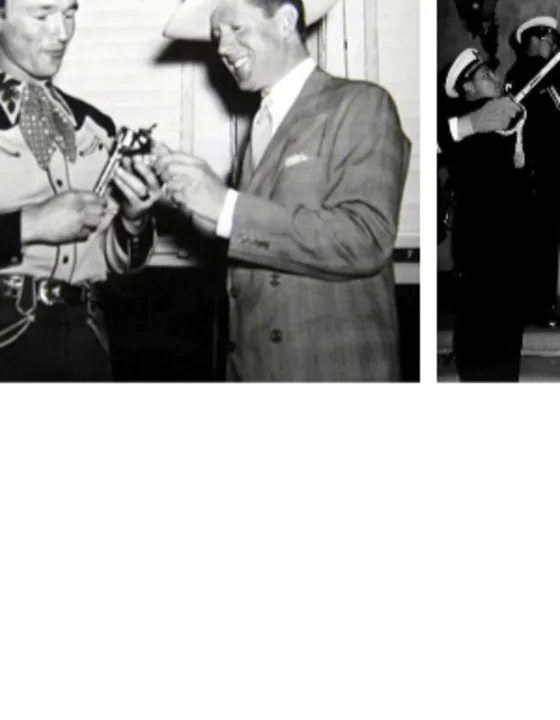
Rudy Vallée was one of the first American entertainers to build mass fame through radio before Hollywood came calling. His transition from the dance halls of New York to the film studios of Los Angeles followed a path that few performers of his era managed to navigate successfully. The intersection of his radio career and Hollywood output offers a precise window into how celebrity was manufactured and sustained in the late 1920s through the 1950s.
Who Was Rudy Vallée Before Hollywood Noticed Him
Hubert Prior Vallée was born on July 28, 1901, in Island Pond, Vermont. He adopted the stage name "Rudy" as a nod to saxophonist Rudy Wiedoeft, whose recordings influenced his early technique. By 1928, Vallée had formed his band, the Connecticut Yankees, and launched a residency at the Heigh-Ho Club in New York City. His NBC radio program, The Fleischmann's Yeast Hour, which debuted in October 1929, turned him into a household name before most Americans had ever seen his face.
Key facts about Vallée's pre-Hollywood profile:
- First major radio variety show host in American broadcasting history
- Estimated weekly audience of 15–20 million listeners by 1930
- Known for performing through a megaphone, a signature image that became iconic
- Yale University graduate (B.A., 1927) — an unusual credential for a pop entertainer of the era
Old Hollywood in the Late 1920s: The Industry Vallée Entered
When Vallée arrived in Hollywood, the studio system was mid-transformation. The Jazz Singer had been released in 1927, and by 1929 the industry was scrambling to sign anyone with a recognizable voice. Radio stars were especially attractive because they came with pre-built audiences.
The major studios operating during Vallée's early film years:
| Studio | Key Output | Notes |
|---|---|---|
| Warner Bros. | Musical talkies, backstage films | Aggressive in signing radio talent |
| RKO Radio Pictures | Musical revues | Natural fit for radio-adjacent names |
| Paramount Pictures | Sophisticated comedies | Strong in New York-adjacent talent |
| Universal Pictures | Lower-budget musicals | Broad distribution reach |
Vallée's first significant film appearance came in 1929 with The Vagabond Lover (RKO), a feature built almost entirely around his radio persona. The film was not a critical success, but it served a commercial function: it put a face and a story to the voice millions already trusted.
Rudy Vallée's Film Career: A Chronological Overview
Vallée's filmography divides into two distinct phases. The first runs from 1929 to roughly 1942, when he played versions of himself or light romantic leads. The second begins with Preston Sturges's The Palm Beach Story (1942), where Vallée demonstrated genuine comic timing and pivoted toward character work.
Phase One: The Radio Star on Screen (1929–1941)
Films from this period leaned heavily on his existing fame rather than on scripted character development. Studios knew audiences would pay to see the man they heard on the radio, so narratives were thin scaffolding around musical performance.
Notable Phase One films:
| Year | Film | Studio | Notes |
|---|---|---|---|
| 1929 | The Vagabond Lover | RKO | Feature debut; semi-autobiographical premise |
| 1929 | Glorifying the American Girl | Paramount | Cameo in Ziegfeld Follies-style revue |
| 1933 | International House | Paramount | Ensemble comedy; radio broadcast framing device |
| 1934 | George White's Scandals | Fox | Stage revue adaptation; multiple musical numbers |
| 1941 | Too Many Blondes | Universal | Later-period romantic comedy |
The recurring problem in Phase One: Vallée played a pleasant but dramatically inert version of himself. Critics of the period noted that his screen presence lacked the danger or unpredictability that defined contemporaries like James Cagney or even fellow crooner Bing Crosby.
Phase Two: The Character Actor (1942–1960s)
Preston Sturges changed Vallée's trajectory with a single role. In The Palm Beach Story, Vallée played John D. Hackensacker III, a fussy, earnest millionaire pursuing Claudette Colbert. The performance was precise and self-aware. Vallée played against his own image — the romantic radio idol — and the result was the best screen work of his career.
This pivot led to a string of character roles:
| Year | Film | Role Type |
|---|---|---|
| 1942 | The Palm Beach Story | Comic millionaire |
| 1943 | Happy Go Lucky | Supporting comedic role |
| 1945 | It's in the Bag! | Satirical cameo |
| 1947 | The Bachelor and the Bobby-Soxer | Supporting character |
| 1967 | How to Succeed in Business Without Really Trying | J.B. Biggley (film adaptation of Broadway role) |
The 1967 film deserves specific attention. Vallée had originated the role of J.B. Biggley on Broadway in 1961, winning a Tony Award. When the film version was made, he reprised the character — one of the few cases in mid-century American entertainment where a performer originated a major Broadway role and carried it to the screen.
Old Hollywood's Social Architecture: Where Vallée Fit
Old Hollywood was not simply a geographic location or an industrial category. It was a social ecosystem with specific hierarchies, clubs, rivalries, and networks. Understanding Vallée's place in that ecosystem requires separating myth from documented fact.
Vallée was not a contract player in the traditional studio sense. He was a visiting attraction — a radio and stage personality who came to Hollywood on specific projects rather than as studio property. This gave him more autonomy than, say, a contract actor at MGM, but it also meant less institutional support and fewer guaranteed films per year.
His social connections in Hollywood included:
- Preston Sturges — the most important creative relationship of his film career
- W.C. Fields — shared screen time in International House; famously difficult working relationship
- Alice Faye — co-starred in George White's Scandals; both were Fox properties in the mid-1930s
- Claudette Colbert — The Palm Beach Story partnership praised by contemporary critics
Vallée's Yale background made him an outlier in an industry where formal education was rare. He occasionally referenced it in interviews and in his memoir, My Time Is Your Time (1962), in ways that suggested mild condescension toward colleagues with less formal schooling — a characteristic that reportedly created friction on certain productions.
Radio, Hollywood, and the Cross-Media Economy of the 1930s
The relationship between radio and film in the 1930s was more competitive than it appears in retrospect. Studios initially feared that radio would keep audiences at home. By the early 1930s, the strategy had shifted: sign radio talent, use films to amplify radio audiences, use radio appearances to drive film ticket sales.
Vallée was one of the clearest examples of this cross-media logic:
- His radio show promoted his films directly through on-air mentions and musical excerpts
- Film appearances were timed around radio broadcast schedules when possible
- Sheet music sales, which radio performance drove, generated separate revenue that reinforced his overall brand
By 1934, Vallée was earning a reported $10,000 per week from radio alone, making him one of the highest-paid entertainers in the United States at the height of the Depression. His film fees were negotiated from a position of strength that purely cinematic stars rarely enjoyed before their second or third major hit.
Vallée's Legacy in the Context of Old Hollywood History
Assessing Vallée's place in Old Hollywood requires separating two questions: how significant was he commercially, and how significant was he artistically?
Commercially, the answer is clear. He was a major figure from 1929 through the mid-1940s, and his Broadway-to-film arc in the 1960s gave him a second documented cultural moment. He was not a peripheral character.
Artistically, the record is more complicated. His early films hold up poorly by almost any standard — they are curios of a transitional moment in sound film, not works of lasting cinematic interest. His Sturges performance and his Biggley are the genuine exceptions.
What makes Vallée historically important is less any individual film and more what his career documents:
- The mechanics of early radio celebrity
- The challenges and possibilities of cross-media careers before the term "multimedia" existed
- The specific social and economic architecture of Old Hollywood during its studio-system peak
- How entertainers from outside the film industry negotiated entry and survival within it
His career also illustrates a pattern that would repeat throughout the twentieth century: the performer who becomes famous in one medium, struggles to fully translate to another, finds an unexpected niche, and achieves a second relevance by playing against type.