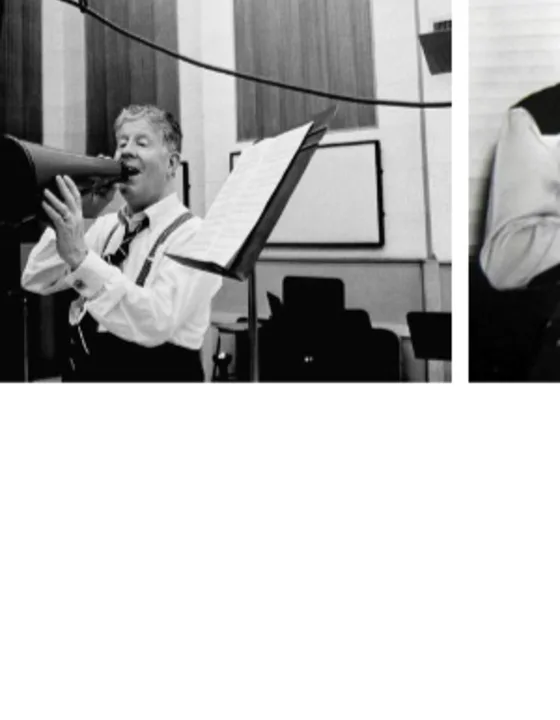
Rudy Vallée did not just sing into a megaphone — he invented a new kind of fame. Before television, before streaming, before the concept of a "media personality" existed, Vallée turned the radio microphone into a direct line between a performer and millions of living rooms across America. What he built in the late 1920s and 1930s became the template every entertainer after him inherited.
Who Was Rudy Vallée
Born Hubert Prior Vallée on July 28, 1901, in Island Pond, Vermont, he adopted the stage name "Rudy" as a tribute to saxophonist Rudy Wiedoeft. He studied at the University of Maine and later at Yale, where he led a dance band that would eventually become his professional vehicle. His formal education gave him an unusual combination of musical discipline and business instinct — rare in the entertainment world of that era.
Key biographical facts:
- Full birth name: Hubert Prior Vallée
- Born: July 28, 1901, Island Pond, Vermont
- Died: July 3, 1986, North Hollywood, California
- Instrument: tenor saxophone, clarinet, vocals
- Yale class: 1927 (attended, did not complete degree)
- Signature prop: the megaphone, used before electronic amplification became standard
The Megaphone Era and What It Actually Meant
The megaphone was not a gimmick. In the late 1920s, venue amplification was unreliable or nonexistent. Vallée used a simple cardboard cone to project his voice across ballrooms and later carried the image into radio broadcasts as a visual brand marker. Audiences associated the megaphone with intimacy — it looked like he was speaking directly to one person.
This soft, conversational delivery style stood apart from the theatrical projection of vaudeville performers. Vallée sang quietly, almost privately. Musicologists now identify this as an early form of the crooner approach that Bing Crosby and later Frank Sinatra would refine. The difference: Vallée got there first and did it without modern microphone technology.
The Fleischmann's Yeast Hour: Radio as Mass Media
In 1929, Vallée launched "The Fleischmann's Yeast Hour" on NBC. The show ran until 1939 — ten years of weekly national broadcasting that made him the most recognized voice in America for most of that decade.
What the show introduced to American radio:
| Innovation | Explanation |
|---|---|
| Guest star format | Vallée brought in outside performers each week, creating the variety show model |
| Cross-promotion | Print, radio, and live performance were coordinated deliberately |
| Fan mail as metric | NBC tracked listener response by volume of mail — Vallée regularly topped the network |
| Branded host identity | The show carried the sponsor's name but Vallée's personality defined it |
By 1930, NBC estimated Vallée received more fan mail than any other performer on the network. Some weeks the volume exceeded 10,000 letters. These were not passive listeners — they wrote back, requested songs, and drove record sales directly.
Discography Highlights: What He Actually Recorded
Vallée recorded prolifically between 1928 and the mid-1940s. His output on Victor Records and later on other labels covered popular standards, novelty songs, and original material from his radio show.
Notable recordings and their context:
| Year | Recording | Label | Notes |
|---|---|---|---|
| 1928 | "Vagabond Lover" | Victor | Became his signature song and film title |
| 1929 | "Deep Night" | Victor | One of his first major radio hits |
| 1929 | "Marie" | Victor | Covered widely; Vallée's version predates Tommy Dorsey's famous 1937 arrangement |
| 1931 | "As Time Goes By" | Victor | Vallée recorded this before Casablanca made it famous |
| 1932 | "Brother, Can You Spare a Dime?" | Victor | Depression-era anthem; his version was among the first major recordings |
The 1931 recording of "As Time Goes By" is a detail most music encyclopedias underreport. Vallée cut the track more than a decade before the 1942 film. His version introduced the song to American audiences.
Film Career: Hollywood Between the Wars
Hollywood signed Vallée because radio audiences already knew his voice. Studios in the early sound era were desperate for performers who could sing credibly on film — a technical requirement that eliminated most silent film stars.
His film appearances:
- "The Vagabond Lover" (1929) — feature debut, built around his radio persona
- "George White's Scandals" (1934) — ensemble musical with Alice Faye
- "Sweet Music" (1935) — Warner Bros., co-starring Ann Dvorak
- "Gold Diggers in Paris" (1938) — late entry in the Gold Diggers series
- "The Palm Beach Story" (1942) — Preston Sturges comedy; Vallée played J.D. Hackensacker III, a role that reinvented his public image as a comic actor
- "How to Succeed in Business Without Really Trying" (1967) — reprised his Broadway role; the film extended his career into a new generation
The Preston Sturges film deserves particular attention. By 1942, Vallée's musical stardom had faded. Sturges cast him specifically against type — as a naive, enormously wealthy eccentric — and the performance worked. Critics who had dismissed him as a period relic reassessed his range.
Broadway and the Second Act
In 1961, Vallée joined the original Broadway cast of "How to Succeed in Business Without Really Trying," playing J.B. Biggley. The show ran 1,417 performances. He won a Tony Award nomination and introduced his work to an audience born after his radio peak.
This arc — from 1920s radio to 1960s Broadway — spans four decades of continuous professional relevance. Few entertainers from the pre-Depression era maintained that kind of longevity across genuinely different media formats.
Vallée's Influence on the Crooner Tradition
The crooner lineage runs in a direct line:
1. Rudy Vallée — soft vocal delivery, microphone/megaphone intimacy, radio as primary medium 2. Bing Crosby — refined the vocal style with better microphone technique, expanded to film 3. Frank Sinatra — added orchestral sophistication, built on Crosby's approach 4. Perry Como, Dean Martin, Tony Bennett — diversified the style into television era
Vallée's contribution was structural: he demonstrated that a performer could build a mass audience through repeated, scheduled broadcasts rather than touring alone. That model — consistent presence on a single platform over time — is the foundation of every podcaster, YouTuber, and streaming artist working today.
What the Archives Preserve
Surviving archival material from Vallée's career includes:
- Original NBC broadcast recordings from "The Fleischmann's Yeast Hour" (selected episodes archived at the Library of Congress)
- Victor Records masters, several reissued on compilation albums
- Correspondence and personal papers donated to Yale University's music library
- Photographs from Hollywood productions held in studio archives
- His autobiography, "Vagabond Dreams Come True" (1930), and a later memoir, "My Time Is Your Time" (1962)
The 1930 autobiography is a primary source document for early radio history. Vallée wrote it while the medium was still forming — his observations about audience behavior and broadcast scheduling reflect a practitioner's understanding of mass communication before the academic field existed.
Timeline: Career at a Glance
| Period | Primary Activity | Medium |
|---|---|---|
| 1920–1927 | College bands, early regional performances | Live venues |
| 1928–1929 | First Victor recordings, New York club work | Records, nightclubs |
| 1929–1939 | "The Fleischmann's Yeast Hour" | National radio (NBC) |
| 1929–1942 | Hollywood films, primarily musical features | Film |
| 1942–1960 | Transition period: comedy roles, club dates | Film, live performance |
| 1961–1967 | Broadway, film adaptation | Stage, film |
| 1967–1986 | Retrospective performances, archival interest | Mixed media |